Tools for Your Tick Prevention Toolbox
Preventing tick bites is the key to keeping loved ones, pets, and yourself healthy. Please consider that nothing is a complete guarantee for tick bite prevention. The content of this information is my opinion only and may not align with the recommendations of other organizations. After my experience with Lyme disease, I have a more extensive view of tick prevention than others. For me, tick prevention when going outdoors is a top priority. Taking precautions to reduce tick exposure and attachment can help prevent an extensive list of infections transmitted by ticks. Please use the information below to build your own Tick Prevention Toolbox.
TICK MISCONCEPTIONS
There are common misconceptions regarding when and how tick bites occur. The most common— ticks are found only in wooded areas. A tick exposure can happen in well-trimmed yards in urban areas, on sidewalks, and if you have only been outside for less than 5 minutes. A tick bite can occur even if you do not go outside, especially if you have indoor pets.
Another misconception is that tick bites do not occur in the winter. An older gentleman from church once told me, “I had a tick bite and had to go to the doctor to have it removed. I thought of you and your illness. I cannot believe that ticks are out even in December.” Please do not forget that ticks are active during the winter months as well. I always say, “Tick season never stops!” By understanding these misconceptions, you can protect your family, pets, and yourself from tick exposure throughout the year.
LAWN MANAGEMENT
Lawn management and maintenance are crucial tools for your Tick Prevention Toolbox. You can decide what is necessary for your lawn based on your views on chemical exposure, environmental impact, and previous tick bite incidents. Lawn management can range from general lawn care to the application of insecticides and other pest control measures.
For the environmentally friendly approach, I love planting marigolds, geraniums, and lemon grass in my garden and potted planters. Also, every year for Mother’s Day, my mom gives me a citronella plant, which I set by my front door. I look forward to receiving the citronella plant as it is one of my favorite gifts. It is not a beautiful flowering plant, nor is it highly decorative, but it is highly efficient at keeping large mosquitoes away from my door. I learned to appreciate not only the beauty of plants but also their protective value.
I am not a large supporter of the excessive use of chemicals. However, keeping a yard neatly trimmed, in addition to removing leaves and debris, was not enough to prevent multiple family members from getting tick bites. While not a tool we had previously used, treating our yard with chemicals was the only way to go outside during the summer months without tick issues. See the following list of lawn management options.
- For an environmentally friendly tick prevention method, plant tick-repelling plants and herbs in your garden or landscaping. Options to plant in your landscaping include lavender, rosemary, wormwood, garlic, mint, geraniums, marigolds, chrysanthemums, and lemon grass. (Lott, 2024)
- Perform routine lawn maintenance by trimming grass and removing debris.
- Seek out a local lawn service or treat your lawn with granular or liquid insect repellent lawn products. The Journal of the American Mosquito Control Association published a study with results showing Bayer Advanced Complete Insect Killer, Spectracide Triazicide Insect Killer, and Ortho Bug-B-Gon to be effective in reducing two types of ticks for up to 4 weeks (Jordan, 2017).
TICK PREVENTION FOR PETS
Options for pet tick prevention include oral medications, topical medications, and collars. Tick repellent products should be used year-round, including winter, as ticks are active even at temperatures as low as 40°F (Cornell University College of Veterinary Medicine, n.d.). Be cautious when purchasing these products and read labels carefully. Check each product’s label for the duration of repellent activity, the type of insects it covers, and the animal weight recommended for the product.
While insect repellent collars are convenient because they last for 8 months, there is concern for animal safety. The EPA has conducted scientific research on the neurological side effects of collar insecticides and the potential for choking due to collar application (Environmental Protection Agency, n.d.). Please ask a veterinarian for specific concerns when selecting a product.
Please see the following options. These lists provide a few examples, but they are not a comprehensive list of all available products.
Examples of products available for Dogs
- Chewable Products: Bravecto, NexGard, and Simparica are classified as isoxazoline products. This class is known to have neurological side effects, which can include seizures.
- Topical Products: K9 Advantix II, Vectra 3D, Frontline, Bravecto
- Collars: Seresto
Examples of products available for Cats
- Chewable Products: Credelio, Comfortis, Bravecto
- Topical Products: Advantage Multi, Frontline, NexGard Combo, Bravecto Plus, Revolution Plus
- Collars: Seresto
WEAR APPROPRIATE OUTDOOR CLOTHING
Selecting the appropriate outdoor clothing is another useful tick prevention tool. I have developed my own routine, which includes wearing tall, fitted boots that seal around my leg and light-colored T-shirts. Additionally, overalls are my go-to choice for outdoor apparel. They are a fantastic way to tuck in your shirt, so you do not have to worry about ticks crawling under loose clothing. Please see the following recommendations.
- Light colored clothing.
- Tuck your pants into your socks.
- Tuck your shirt into your pants.
- Pull up your hair and wear a hat.
INSECT REPELLENT SPRAYS
There are many repellent spray choices for your tick prevention toolbox. Selecting the most appropriate product for you will depend on your preference for herbal versus chemical sprays. I routinely spray my clothing and shoes with a DEET-based insect repellent when going outside. I also apply Fairy Tales Bug Bandit herbal-based spray on my neck and behind my ears. Always remember that even though you use preventive bug repellent sprays, a tick bite might still occur. Read labels carefully for ingredients. Do not use bug repellent sprays on children under 2 months of age. According to the American Academy of Pediatrics, DEET products can be applied to children, but should not contain more than 30% DEET. Refer to a pediatrician for questions regarding the most appropriate insect repellent for children. Please see the following recommendations.
- Permethrin products are applied to clothing only. Do not spray on your skin. Read the label for product duration. Some examples of permethrin-containing products include Sawyer Permethrin Insect Repellent for Clothing, REPEL Permethrin Clothing & Gear, and Insect Shield Permethrin Spray.
- DEET is a common ingredient in bug repellent sprays. For effective repellent activity, choose products with a DEET percentage ranging from 10% to 30%. Deet repellent products can be applied directly to skin and clothing. Examples of DEET-containing products include OFF!, REPEL, and Cutter.
- Picaridin is another commonly used ingredient in bug repellent sprays that can be applied to skin and clothing. My personal experience with picaridin-containing products resulted in several mosquito bites, despite thorough application to the skin. As a result, I do not often use picaridin spray products. Examples of picaridin products are OFF!, REPEL, and Sawyer brands.
- Herbal products serve as an alternative to chemical-based products. However, less research is available regarding their efficacy, safety, and duration. Products containing DEET, permethrin, or picaridin are more extensively researched for safety and efficacy as insect repellants. According to the American Academy of Pediatrics, do not use oil of Lemon Eucalyptus (OLE) or para-menthane-diol (PMD) on children under 3 years old. Ingredients in herbal products can include peppermint oil, lemon grass oil/lemon essential oil, rosemary, soybean oil, eucalyptus, citronella, lavender, and tea tree oil. I have tried the following herbal products, Fairy Tales Bug Bandit and Tick Guard, for application in areas near my face and hairline.
TICK CHECKS AND SELF-CARE
The most essential tool for your toolbox is to properly check yourself for ticks after being outdoors. Perform these steps recommended by the U.S. Forest Service.
- Bathe or shower as soon as you come indoors to remove any crawling ticks.
- Perform a full body check for any remaining ticks. Use a mirror to inspect your entire body, including the areas between your toes. Pay extra attention during tick checks to the following areas: underarms, behind and inside ears, belly button, behind the knees, neck, hair, waist, and groin area.
- Wash clothing worn outdoors using hot water and then dry clothes on high heat.
(U.S. Forest Service, n.d.)
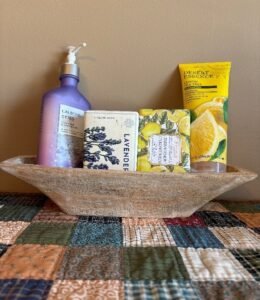
I have incorporated a self-care routine into my tick prevention toolbox by utilizing essential oil bath products and lotions. Strongly scented products, containing lavender, lemongrass, peppermint, and eucalyptus, can repel ticks, but their effectiveness is not well-researched. However, they are relaxing and rejuvenating after being outside. They give me peace of mind that I have taken a final step in tick prevention. See the list below for examples.
- Dessert Essence Lemon Tea Tree Shampoo.
- Lavender, lemon, peppermint, and eucalyptus essential oil bar soaps of any brand.
- Lavender or peppermint essential oil lotions (Calming Skies).
References
- American Academy of Pediatrics. (2024, January 10). Insect repellents. https://www.aap.org/en/patient-care/environmental-health/promoting-healthy-environments-for-children/insect-repellents/
- Cornell University College of Veterinary Medicine. (n.d.). Flea and tick prevention. Riney Canine Health Center. https://www.vet.cornell.edu/departments-centers-and-institutes/riney-canine-health-center/canine-health-information/flea-and-tick-prevention
- S. Environmental Protection Agency. (2023, July 13). EPA requires additional mitigation measures for Seresto pet collars. https://www.epa.gov/pesticides/epa-requires-additional-mitigation-measures-seresto-pet-collars
- Jordan, R.A., Schulze, T.L., Eisen, L., Dolan, M. C., (2017). Ability of Three General-Use Pesticides To Suppress Nymphal Ixodes scapularis and Amblyomma americanum (Acari: Ixodidae). J Am Mosq Control Assoc. 33. (1). 50-55. https://doi.org/10.2987/16-6610.1
- Lott, L. (2024, April 24). The power of plants in tick prevention. Global Lyme Alliance. https://www.globallymealliance.org/blog/the-power-of-plants-in-tick-prevention
- S. Environmental Protection Agency. (2023, July 13). EPA requires additional mitigation measures for Seresto pet collars. https://www.epa.gov/pesticides/epa-requires-additional-mitigation-measures-seresto-pet-collars
- S. Forest Service. (n.d.). Checking for ticks. U.S. Department of Agriculture. https://www.fs.usda.gov/visit/know-before-you-go/ticks